Independent homeowner guide
Heat pumps can reduce dependence on oil and gas, but the best system depends on the property, available space, existing heating, budget and how long the homeowner expects to remain in the house.
This guide explains what the main types do, what installation may look like, and the important advantages, disadvantages and quality features to compare.
Important: A heat pump collects renewable heat from the air, ground or water around the property, but it still uses purchased electricity. It reduces direct reliance on oil or gas, but electricity prices, maintenance and finance costs still matter.
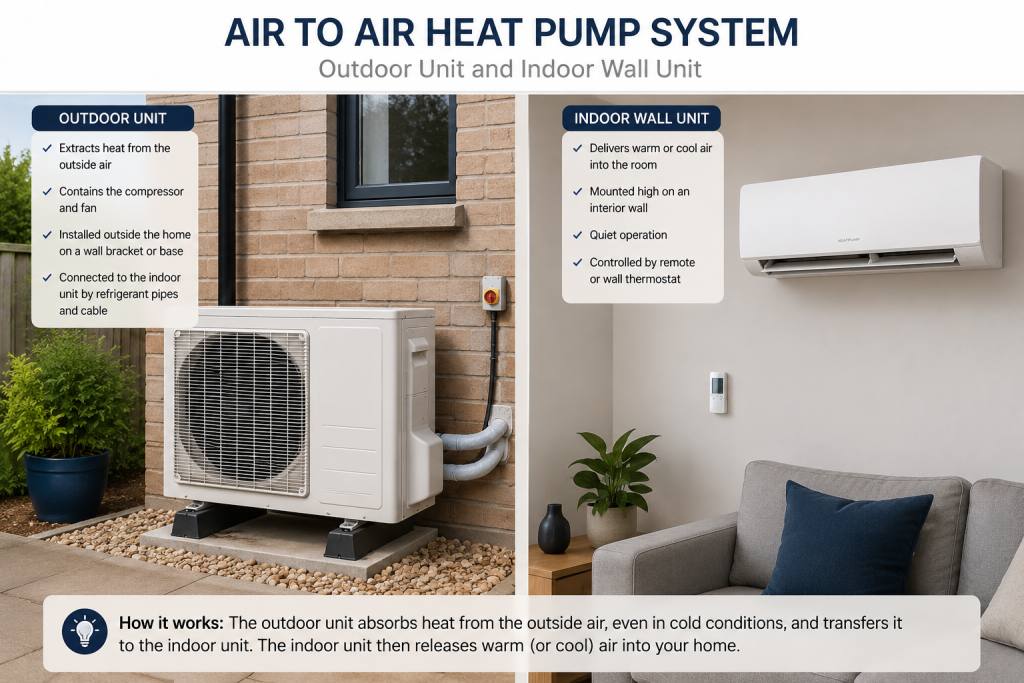
It collects heat from outdoor air and sends warm air directly into rooms through indoor fan units. Many systems can also cool rooms in summer.
It does not normally heat water for taps, showers or conventional radiators, so a separate hot-water system is usually needed.
Best suited to: Open-plan homes and individual rooms
Usually providesHeating and cooling
Main limitationUsually no hot water
Advantages
- Usually quick and relatively inexpensive to install.
- Can provide summer cooling.
- No wet central-heating pipework required.
- Useful for extensions and garden offices.
Things to consider
- Indoor fan units remain visible.
- Fan noise and air movement may not suit everyone.
- Heat may not spread evenly through many closed rooms.
- A separate water-heating system is normally required.
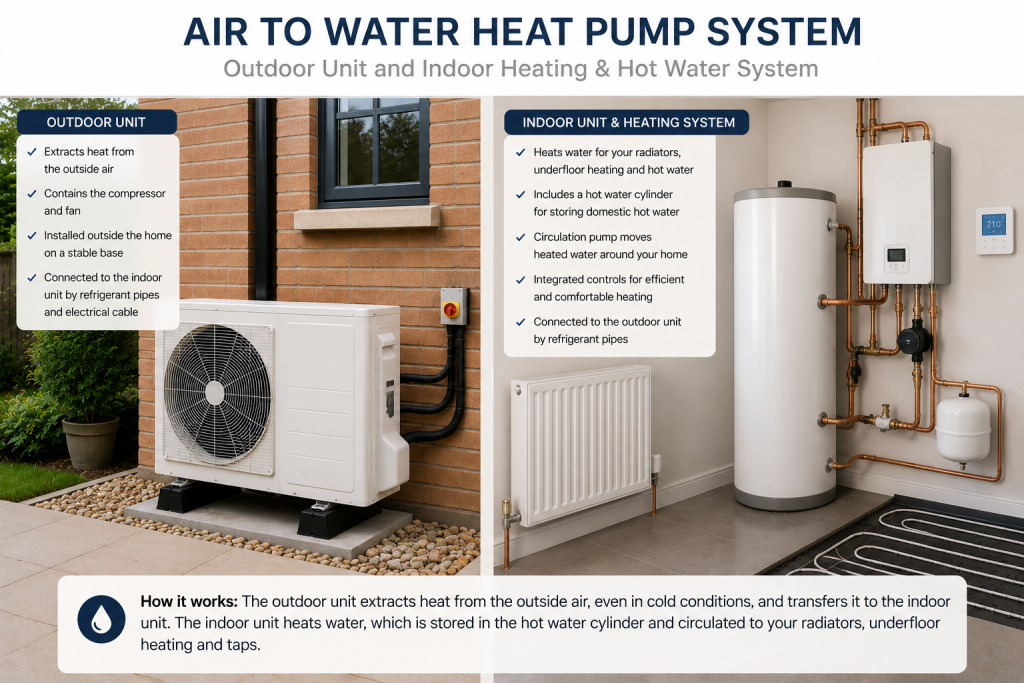
It collects heat from outdoor air and transfers it into water for radiators, underfloor heating and a hot-water cylinder.
This is often the most practical whole-house alternative to a gas, oil or LPG boiler, although radiator, cylinder or pipework upgrades may be needed.
Best suited toMost ordinary houses
Usually providesHeating and hot water
Main limitationOutdoor unit and possible upgrades
Add an image here
Suggested image: outdoor unit, cylinder and upgraded radiator.
Advantages
- Can replace a conventional boiler.
- Usually cheaper than ground-source heating.
- Works well with correctly sized radiators or underfloor heating.
- Can later work with solar panels and smart tariffs.
Things to consider
- May need a larger hot-water cylinder.
- Some radiators may need replacing.
- The outdoor unit makes some noise.
- Good design and low flow temperatures are important.
Ground-source system
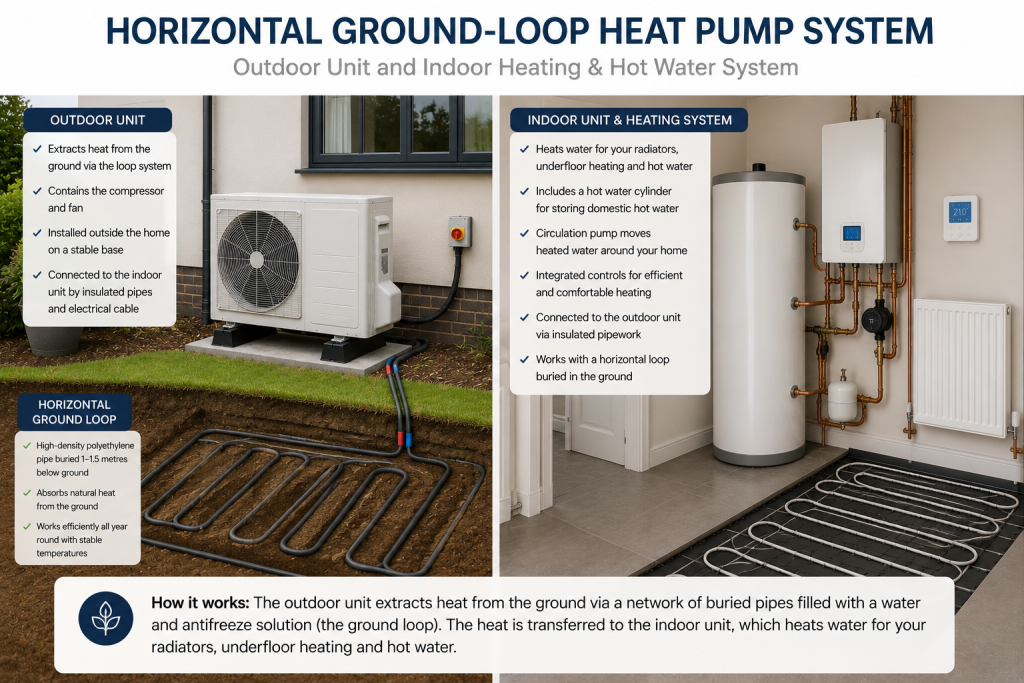
It collects heat from pipes buried in shallow trenches across a suitable area of land, then transfers that heat into the home’s heating and hot-water system.
Ground temperatures are steadier than outdoor air temperatures, which can improve winter efficiency.
Best suited toHomes with substantial land
Usually providesHeating and hot water
Main limitationExcavation and land requirement
Suggested image: trenches before the garden is restored.
Advantages
- Stable source temperature.
- No large fan unit beside the house.
- Ground loops can have a long life.
- Excavation may sometimes be arranged separately.
Things to consider
- Requires a large suitable area.
- Gardens and paths may be disturbed.
- Higher installation cost than air source.
- Ground conditions need professional assessment.
Ground-source system
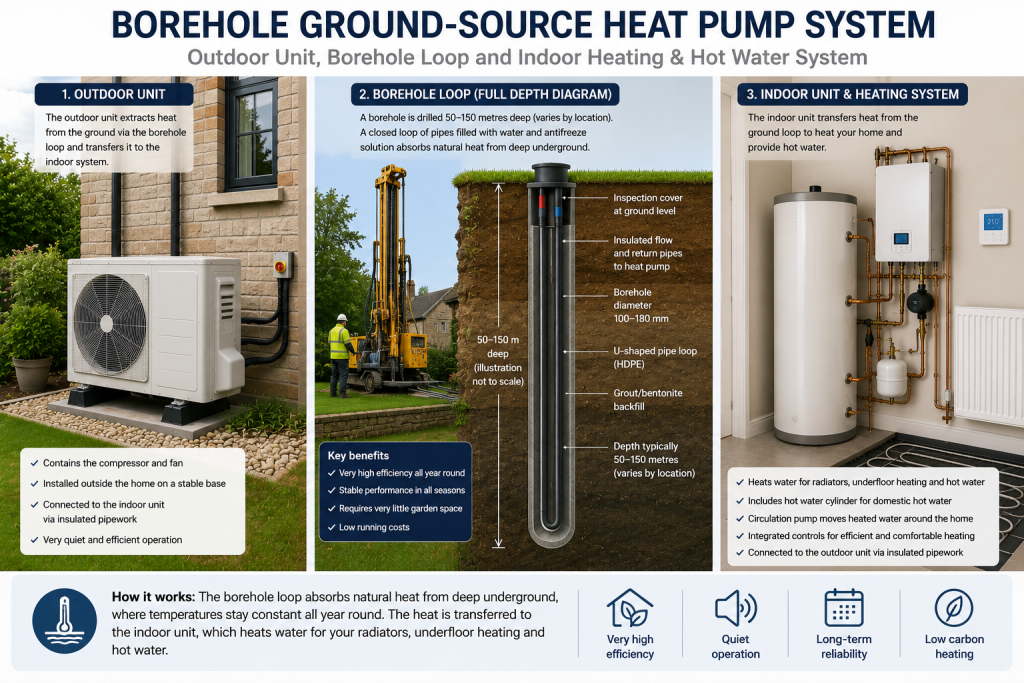
It collects heat through one or more deep vertical boreholes. This gives the benefits of ground-source heating without needing a large horizontal field.
It can be highly efficient, but specialist drilling makes it one of the most expensive domestic options.
Best suited toLimited land with drilling access
Usually providesHeating and hot water
Main limitationHigh drilling cost
Add an image here
Suggested image: drilling rig and finished garden.
Advantages
- Stable underground temperatures.
- Uses little surface land.
- Ground infrastructure may last a long time.
- Can provide strong seasonal efficiency.
Things to consider
- Drilling is expensive and specialist.
- Access and geology affect suitability.
- The technically best system may still be a poor financial choice.
- Very long theoretical loan periods may not be available.
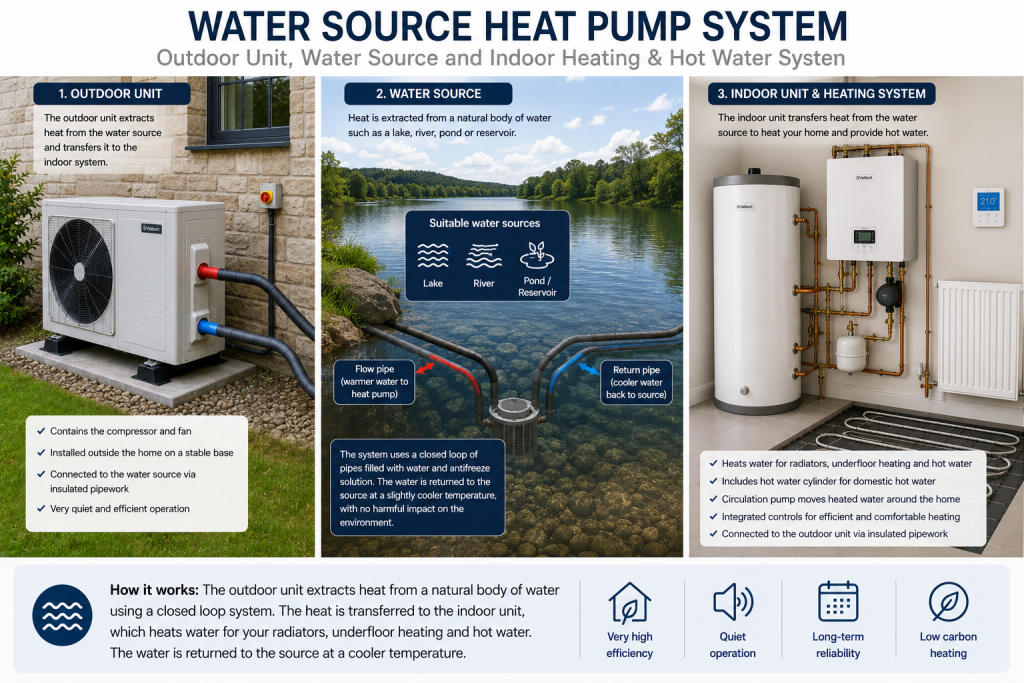
It collects heat from a suitable lake, river, pond or underground water source and transfers it into the property’s heating system.
It can be efficient, but relatively few homes have the access, permissions and suitable conditions required.
Best suited toHomes beside suitable water
Usually providesHeating and hot water
Main limitationRare site suitability
Add an image here
Suggested image: collector pipes and indoor equipment.
Advantages
- Water can provide a stable heat source.
- No air-source fan unit is required.
- Can offer high efficiency on the right site.
- May suit rural homes with private water access.
Things to consider
- Permissions and water rights may be involved.
- Filters and source equipment may need maintenance.
- Flooding, debris and seasonal conditions matter.
- Specialist quotations can vary considerably.
What makes one installation better than another?
Brand names alone do not guarantee a good result. Survey quality, system design, controls, installation and commissioning can be just as important as the heat-pump unit.
Basic installation
- Standard controls.
- Fewer monitoring features.
- Potentially more audible operation.
- Shorter warranty or limited support.
Good mid-range installation
- Weather compensation.
- Variable output.
- Good cold-weather performance.
- Energy monitoring.
- Good installer support.
Premium features
- Very quiet operation.
- Advanced smart controls.
- Solar, battery and tariff integration.
- Longer warranties.
- Higher-quality cylinders and pumps.
Questions to ask before accepting a quotation
| Question | Why it matters |
|---|---|
| Was a room-by-room heat-loss calculation completed? | Rough estimates can lead to poor sizing and higher costs. |
| What efficiency is expected at the proposed flow temperature? | Headline figures may not match real operation. |
| Which radiators, pipework or cylinders need replacing? | This explains differences between quotations. |
| What are the indoor and outdoor noise levels? | Noise affects placement, neighbours and comfort. |
| What warranty covers the unit, labour and other equipment? | An equipment warranty may not cover installation faults. |
| Can performance be monitored after installation? | Monitoring can reveal poor settings or unexpected energy use. |
Could a heat pump add value to a property?
A modern low-carbon heating system, lower running costs and a better EPC rating may make a home more attractive to some buyers. Any increase depends on the property, location, local market, installation quality and buyer preferences.
It is safer to treat a possible value increase as an additional benefit rather than relying on it to repay the installation cost.
Can the home be changed back to a boiler later?
In many homes another boiler could technically be installed later. Radiators and some internal pipework may remain useful, but the cost depends on what was removed and whether a suitable gas, oil or LPG supply remains.
Ground loops and boreholes would normally remain in place even if the indoor heat-pump unit was replaced.
General guide only: Installation costs, performance, permissions, grant eligibility and property-value effects must be checked for the individual home.