
Upcoming Technologies | 27 October 2026
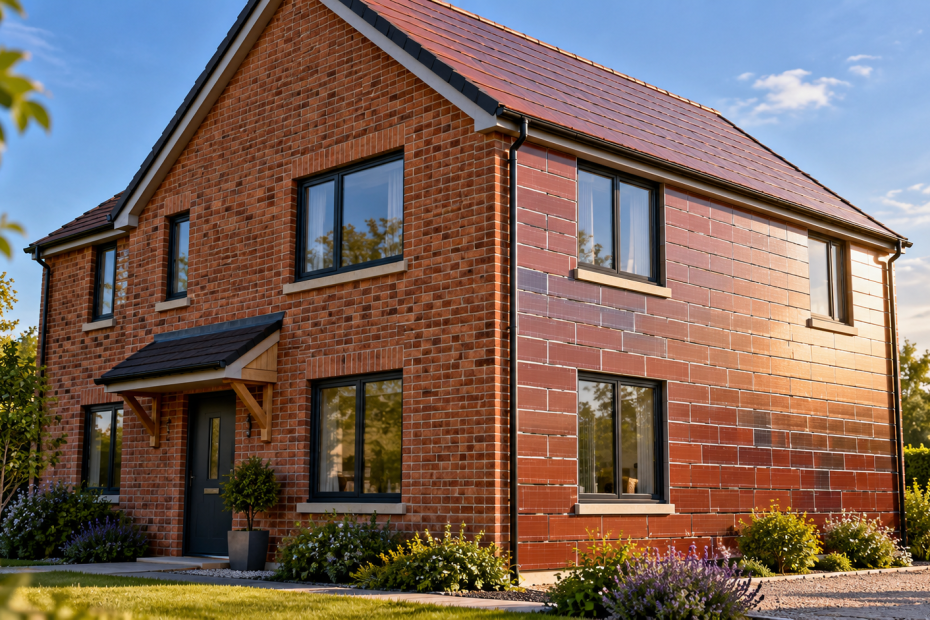
Imagine a house where the roof tiles generate electricity, the exterior walls double as solar panels, and the technology is almost invisible.
That is becoming increasingly realistic thanks to developments in Germany, where researchers are finding ways to make solar panels blend into buildings without sacrificing much of their electricity-generating capability.
At the Intersolar Europe 2026 exhibition in Munich, the Fraunhofer Institute for Solar Energy Systems (ISE) showcased a technology called ShadeCut, which can make photovoltaic panels resemble traditional roof tiles, brickwork and other architectural surfaces.
The development could be particularly interesting for homeowners who want solar power but dislike the appearance of conventional black panels.
How can solar panels look like bricks or roof tiles?
Traditional solar panels are designed primarily to capture as much sunlight as possible. Their dark appearance helps with this, but it also makes them stand out against many buildings.
Fraunhofer ISE has developed a different approach.
Its MorphoColor technology creates colours using microscopic surface structures rather than relying on conventional coloured pigments that can absorb substantial amounts of incoming light.
The technique was inspired by the Morpho butterfly, whose wings produce brilliant colours through the way their microscopic structures interact with light.
The newer ShadeCut development builds on this technology.
Researchers use precisely cut coloured films to create patterns across the surface of solar modules. These can imitate materials such as roof tiles or masonry while leaving areas transparent so sunlight can still reach the solar cells.
The result is a solar panel that can look much more like part of a building rather than an additional piece of equipment attached to it.
How efficient are coloured solar panels?
One of the most impressive aspects of the technology is how little electricity generation needs to be sacrificed for colour.
According to Fraunhofer ISE, independent measurements show that solar modules using MorphoColor coatings can retain approximately 95% of the power output of comparable uncoated modules.
To put this into perspective, consider a conventional solar panel rated at 450 watts.
If a coloured version retained 95% of its output under comparable conditions, it would produce approximately:
450 W × 95% = 427.5 W
That is a difference of just 22.5 watts in this illustrative comparison.
The exact performance of a finished product will depend on its design, colour, orientation and installation conditions. The 95% figure is not a guarantee for every possible ShadeCut pattern.
Nevertheless, it suggests that homeowners may eventually have considerably more freedom over the appearance of their solar installations without giving up a large proportion of their potential electricity generation.
Solar walls: Could the outside of your house generate electricity?
One of the most interesting possibilities is using solar technology on walls as well as roofs.
This approach is known as building-integrated photovoltaics, usually shortened to BIPV.
Instead of attaching conventional solar panels to an existing structure, photovoltaic materials become part of the building itself.
Potential applications include:
- Roof coverings that resemble conventional tiles.
- Exterior wall panels designed to match brickwork or cladding.
- Solar balcony panels and railings.
- Architectural façades incorporating coloured photovoltaic glass.
- Solar elements designed to blend into historic buildings.
This could allow architects to include solar generation in places where conventional black panels would be visually unsuitable.
However, an important consideration is that a vertical wall generally receives sunlight differently from a suitably angled roof.
A solar wall may therefore generate less electricity per installed kilowatt over a year, depending on its orientation, shading and location.
The advantage is that it can make use of additional building surfaces that might otherwise generate no electricity at all.
Could coloured solar panels help historic buildings?
Traditional solar panels can be difficult to integrate visually into older properties, particularly those with distinctive roofs or architectural features.
Coloured solar modules could provide a less conspicuous alternative.
A roof-integrated system designed to resemble red clay tiles, for example, might be much less noticeable than conventional black panels mounted above the roof.
Fraunhofer ISE has also investigated public acceptance of solar panels on buildings and found that matching the colour of the roof or façade can improve how people perceive their appearance.
This does not mean that solar installations on listed buildings will automatically receive approval. Planning permission and listed building consent may still be required, depending on the property and proposed work.
Nevertheless, the technology could give designers more options.
Are coloured solar panels already available?
Coloured photovoltaic technology is not entirely new.
Fraunhofer ISE installed green MorphoColor solar modules on one of its research buildings in Freiburg in 2022, demonstrating that coloured panels can operate as part of a real building façade.
The latest ShadeCut development adds more detailed patterns and realistic surface appearances.
However, there is an important distinction between a working demonstration and a product that is widely available to homeowners.
As of October 2026, ShadeCut is best regarded as an emerging technology rather than a standard product available from most UK domestic solar installers.
Some specialist building-integrated and coloured photovoltaic products are already available commercially, but their specifications and availability vary.
Homeowners considering such systems should ask for independently verified performance data, installation warranties and evidence that the proposed system meets relevant UK requirements.
Will solar walls and coloured panels cost more?
There is not yet enough publicly available pricing information to give a reliable UK installed price for ShadeCut systems.
Initially, specialist coloured or patterned modules may cost more than conventional panels because of additional manufacturing processes, limited production volumes and bespoke installation requirements.
However, the economics could become more interesting when solar panels replace materials that a building would otherwise need.
For example, a solar façade could potentially serve as both exterior cladding and an electricity-generating surface.
In that situation, the appropriate comparison is not simply the cost of solar panels versus ordinary panels. It is the total cost of the building exterior, installation, maintenance and electricity generation over its lifetime.
What does this mean for UK homeowners?
For most households considering solar panels today, conventional rooftop photovoltaic systems remain the more established option.
They benefit from a competitive installation market, well-understood performance characteristics and a wider choice of equipment.
Coloured solar panels may become attractive for properties where appearance is particularly important or where additional building surfaces could be used for electricity generation.
Before choosing any solar installation, homeowners should consider:
- Expected annual electricity generation, rather than panel efficiency alone.
- The orientation and shading of the proposed surfaces.
- The installed cost and likely financial savings.
- Product and workmanship warranties.
- Planning and building regulations.
- The availability of qualified installers and replacement components.
The future: Buildings that generate their own electricity
The most exciting aspect of this development is the possibility that solar technology will gradually become an ordinary part of building design.
Rather than choosing between an attractive home and visible solar panels, homeowners may eventually be able to incorporate electricity generation into the roof, walls and other exterior surfaces.
ShadeCut is not a revolutionary new solar cell that suddenly doubles electricity production.
Its innovation is different: making solar generation easier to integrate into the buildings people already want to live in.
Combined with advances in high-efficiency solar cells, home batteries and smart energy management, this could help future homes generate more of their own electricity without looking like miniature power stations.
For now, it is a promising development worth watching.
Sources and further reading
- Fraunhofer ISE — Coloured films enable patterns on PV modules (23 April 2026)
- Fraunhofer — High-efficiency coloured solar panels for buildings (12 June 2024)
- Fraunhofer ISE — First green solar modules integrated into a building façade (2022)
The Homestead Project follows emerging renewable energy technologies and examines their practical potential for UK households.