Types of Solar Panels: Which Are Best for Your Home?
There are several types of solar panels, and choosing the right technology can affect how much electricity you generate from the available roof space.
Most domestic solar installations now use crystalline silicon panels, but there are important differences between individual technologies. New developments could also allow future panels to generate considerably more electricity from the same area.
This guide explains the main solar panel technologies available today and looks at what could replace them in the future.
Monocrystalline Solar Panels
Monocrystalline panels use solar cells manufactured from single-crystal silicon. They have become the standard choice for many residential solar installations.
Their relatively high efficiency means they can generate more electricity from a limited roof area than older, less efficient technologies.
Advantages
- High efficiency
- Good use of limited roof space
- Long expected working life
- Widely available
- Large choice of manufacturers and power ratings
Disadvantages
- Higher-performance models can cost more
- Performance still depends heavily on roof direction, shading and location
For most UK homes, a modern high-efficiency monocrystalline panel is a sensible starting point.
PERC Solar Panels
PERC stands for Passivated Emitter and Rear Cell.
PERC technology improved conventional silicon cells by adding a passivation layer to the rear of the cell. This allows the cell to make better use of light that would otherwise be lost.
PERC became extremely common in high-performance solar panels, although newer technologies such as TOPCon are increasingly succeeding it.
For someone buying a new installation today, the underlying cell technology is generally more important than simply looking for the word “monocrystalline”.
TOPCon Solar Panels
TOPCon stands for Tunnel Oxide Passivated Contact.
It is an evolution of crystalline silicon solar technology designed to reduce electrical losses within the cell and improve efficiency.
TOPCon has become an important mainstream technology and is increasingly found in modern high-output residential panels.
Advantages
- Higher efficiency than many older PERC designs
- Good performance from limited roof space
- Lower degradation can be available on high-quality products
- Increasingly widely available
For a new domestic installation, TOPCon is one of the technologies worth considering when comparing modern panels.
Heterojunction (HJT) Solar Panels
Heterojunction solar cells combine crystalline silicon with very thin layers of amorphous silicon.
This construction can achieve high efficiency and good performance at elevated temperatures.
HJT is particularly interesting where the objective is to obtain as much electricity as possible from a limited roof area.
Its disadvantage is primarily cost and manufacturing complexity compared with more conventional technologies.
Interestingly, HJT can also form the silicon part of future tandem solar cells. Oxford PV, for example, currently uses HJT as the lower silicon cell in its perovskite-silicon tandem technology.
Back-Contact Solar Panels
Traditional solar cells have visible electrical contacts across the front surface. These contacts occupy some of the area that could otherwise receive sunlight.
Back-contact cells move the electrical contacts to the rear.
This can improve efficiency while also producing the uniform black appearance that many homeowners prefer.
High-performance back-contact panels can therefore be particularly attractive where roof area is more important than obtaining the cheapest possible panel.
Bifacial Solar Panels
Most conventional solar panels collect sunlight only from the front.
A bifacial panel can also collect light reaching the rear of the panel.
This can be useful where sunlight reflects from a light-coloured surface beneath the array.
Bifacial panels are particularly interesting for ground-mounted systems, flat roofs, solar canopies and other installations where the rear of the panel remains exposed.
They generally provide much less additional benefit when mounted very close to a conventional pitched roof because little useful light reaches the rear surface.
Thin-Film Solar Panels
Thin-film solar technology deposits photovoltaic material in very thin layers rather than using conventional crystalline silicon wafers.
Thin-film panels can potentially be lighter and more flexible than conventional panels.
However, they generally require more surface area for a given amount of power. This makes them less attractive for many domestic roofs where space is limited.
Their properties can make them useful for specialist applications and building-integrated solar.
Which solar panels are best for UK homes?
There isn’t one panel that is best for every property.
For most homes, modern high-efficiency monocrystalline panels using technologies such as TOPCon, HJT or back-contact cells are likely to be the main choices.
Where roof space is plentiful, obtaining the best balance between panel price, warranty and performance may matter more than achieving maximum efficiency.
Where roof space is restricted, paying more for higher-efficiency panels can make sense because they allow greater generating capacity to fit on the available roof.
Our Solar Panel Calculator can estimate the generating capacity and number of panels required for your electricity use.
Does living further north mean you need a different type of solar panel?
Not necessarily.
A home in Scotland receives less annual solar energy than an equivalent optimally positioned home in southern England, but that doesn’t automatically require a completely different solar technology.
Instead, the property may require more installed panel capacity to produce the same annual amount of electricity.
High-efficiency panels become particularly useful where the combination of lower solar yield and limited roof area makes it difficult to install enough generating capacity.
Roof orientation, shading and pitch can be just as important as geographical location.
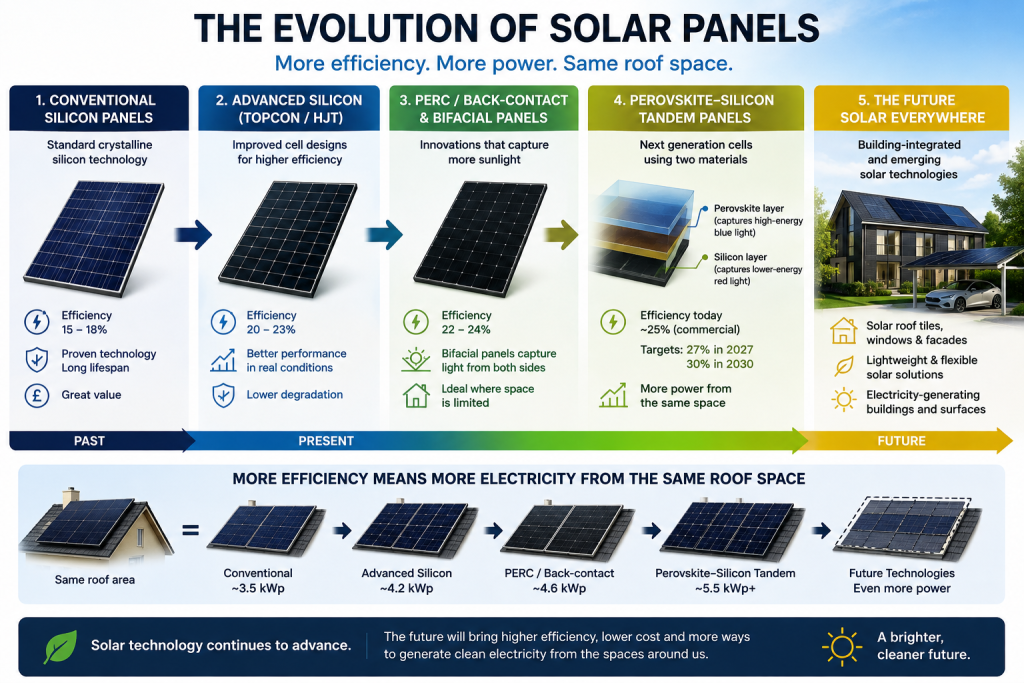
What will replace today’s solar panels?
Solar technology is still developing rapidly. Today’s silicon panels are unlikely to represent the final form of photovoltaic technology.
Several technologies could substantially change domestic solar during the coming decade.
Perovskite Solar Cells
Perovskites are a family of materials with excellent light-absorbing properties. Researchers can adjust their composition to absorb particular parts of the light spectrum.
This makes them particularly interesting for solar cells.
Perovskite cells can also use extremely thin active layers, potentially reducing material requirements.
The major challenge has historically been turning impressive laboratory efficiency into panels that can survive outdoors reliably for decades.
Perovskite-Silicon Tandem Solar Panels
This is probably the future technology I would highlight most prominently on your page.
Instead of replacing silicon completely, a tandem solar cell places a perovskite cell over a silicon cell.
The two materials capture different parts of sunlight.
A conventional silicon cell cannot efficiently convert the entire solar spectrum. In a tandem cell, the perovskite upper layer captures part of the spectrum while the silicon underneath captures another part.
That allows considerably greater efficiency from the same physical area.


6
This is no longer merely a theoretical laboratory technology.
Oxford PV began shipping commercial perovskite-silicon tandem modules in 2024. In June 2026, Oxford PV and Fraunhofer ISE demonstrated a 491 W rooftop tandem module with an area of 1.92 m² and module efficiency of 25.6%.
Oxford PV says its current tandem modules are around 25% efficient and has a roadmap targeting 27% in 2027 and 30% in 2030. These are company targets rather than guaranteed future performance, but they demonstrate where commercial development is heading.
Why would 30% efficient panels matter?
Imagine two houses with exactly the same amount of usable roof.
If one generation of panels achieved around 20% efficiency and a future technology achieved around 30%, the second could potentially produce roughly 50% more peak power from the same panel area, before considering other system differences.
That’s particularly important for the sort of household your calculator is designed around.
A home might eventually need electricity for:
normal household use + heat pump + electric car
The limiting factor may therefore become roof area rather than electricity demand.
Higher-efficiency tandem panels could make a substantial difference.
Could windows eventually generate electricity?
Another developing area is building-integrated photovoltaics (BIPV).
Rather than attaching conventional panels to a completed building, photovoltaic materials can potentially form part of:
- Roof tiles
- Building façades
- Canopies
- Balconies
- Some glazing
- Other construction materials
The long-term idea is that we stop thinking of solar as equipment attached to a building and start making the building itself generate electricity.
Solar roof tiles
Solar roof tiles already exist.
Instead of mounting a panel above ordinary tiles, photovoltaic cells form part of the roof covering.
They can produce a cleaner appearance, particularly on a new roof, but conventional panels are generally simpler and more economical.
The economics could become more attractive for new-build properties or where a roof already needs replacing.
Flexible and lightweight solar
Thin-film and emerging photovoltaic materials could also allow much lighter solar products.
That could make solar practical on roofs that cannot easily support conventional glass modules and could expand applications to vehicles, curved surfaces and portable structures.
Perovskite tandem technology is already being investigated for vehicle applications in the UK.
Will today’s solar panels become obsolete?
Probably not suddenly.
Modern silicon panels can continue producing electricity for decades. A new technology becoming more efficient does not make an existing solar installation stop being useful.
Instead, we are likely to see a gradual transition.
Today’s mainstream
Silicon → PERC/TOPCon/HJT/back-contact
Emerging
Higher-efficiency silicon → perovskite-silicon tandem
Longer term
Tandem/multi-junction → lightweight and building-integrated solar → increasingly efficient electricity-generating surfaces
Crystalline silicon still accounts for more than 90% of photovoltaic systems, illustrating just how established the technology has become.
Should I wait for better solar panels?
For most homeowners, probably not solely because more efficient technology is coming.
A future panel producing more electricity per square metre is most valuable when roof area is the limiting factor.
If your roof already has enough room to install the solar capacity you require with current panels, waiting several years for higher efficiency may provide relatively little benefit.
If you have very limited roof space and very high future electricity requirements, emerging high-efficiency tandem panels become much more interesting.
The important question is therefore not simply:
“What is the most efficient solar panel?”
It is:
“How much electricity do I need to generate, and how much suitable space do I have?”
Use our Solar Panel Calculator to estimate your household electricity requirement, the solar capacity needed and approximately how many panels could provide it.