
How solar-powered cooking works
A portable power station stores electricity in a battery. You plug an electric cooker into its UK mains socket and use solar panels to recharge the battery whenever sunshine is available.
For emergency planning, start with one cooked meal per household per day. Breakfast and lunch can use no-cook pantry foods.
The calculator below estimates three separate things: energy for cooking (Wh), battery storage (Wh) and solar panel power (W). The cooker’s wattage must also be within the power station’s continuous AC output rating.
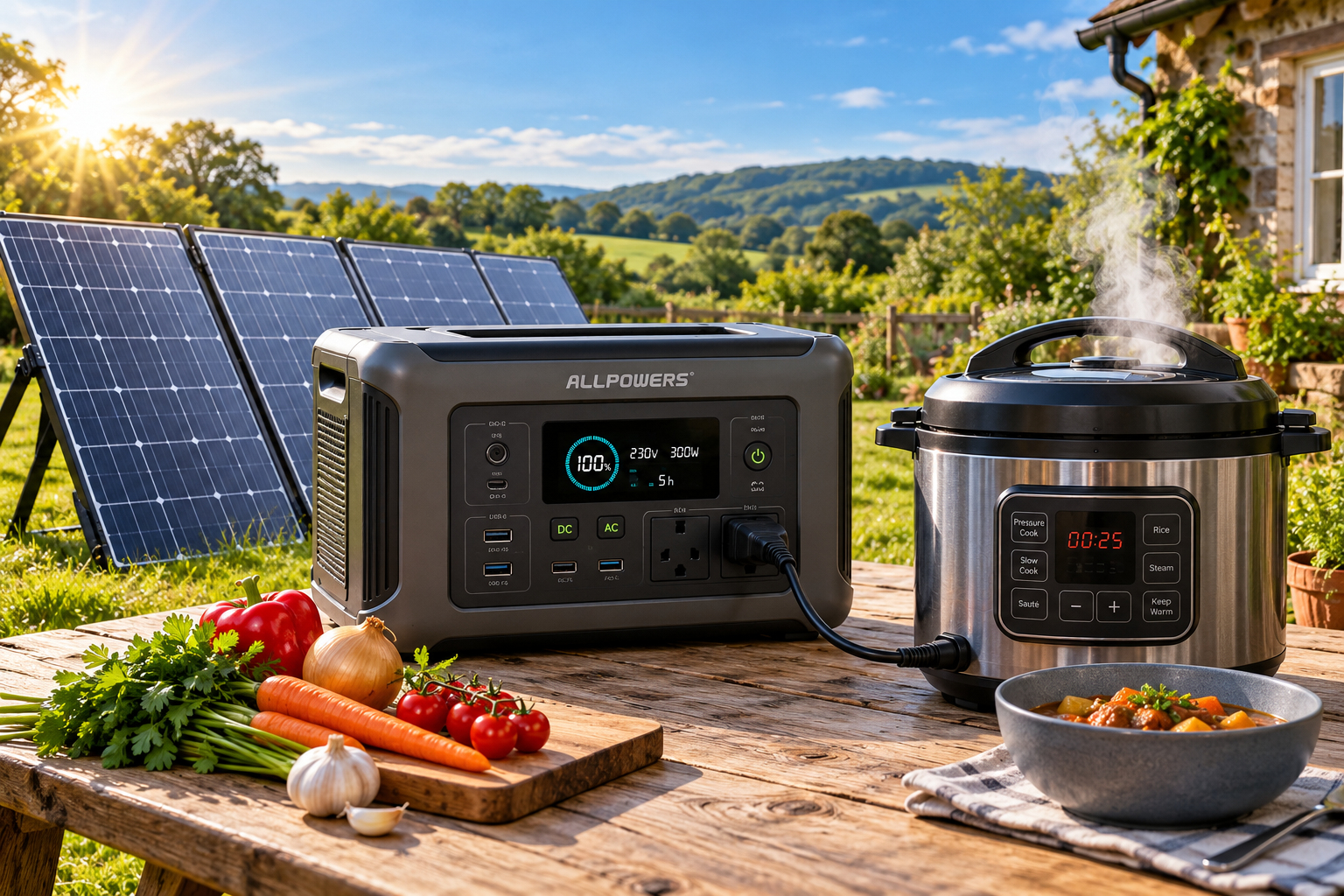
Could you prepare hot meals during a power cut without gas, charcoal or a mains electricity supply? A portable solar power station, compatible solar panels and an efficient electric cooker can make this possible. The key is choosing equipment that works together—and understanding what it can realistically do during a British winter.
How the system works
1. Cook: Plug an electric cooker into the power station’s ordinary UK mains socket. The cooker’s wattage (W) must be below the power station’s continuous AC output (W). For example, a 900W cooker needs a station capable of supplying at least 900W continuously, ideally with spare capacity.
2. Store: The battery is measured in watt-hours (Wh). A 1,000Wh battery stores roughly enough energy for three 300Wh cooking sessions before allowing for conversion losses and other use.
3. Recharge: Solar panels are rated in watts (W), not Wh. A 400W array might collect roughly 400Wh in one equivalent full-sun hour before losses, but UK winter output can be far lower. The panels must also match the power station’s solar input specifications.
How much electricity does one hot meal a day need?
During an emergency, a practical plan is one cooked evening meal for the household, with cereal, bread, tinned food or other no-cook options for breakfast and lunch. The calculator defaults to that arrangement. Increase the number of hot meals only if you expect to cook more often. One cooking session can make several portions.
Use this calculator to estimate energy consumption, battery capacity and solar-panel requirements. A “cooking session” is one batch of food cooked for the whole household—not one session per person. Larger families may need extra batches.
Method: sessions/day = meals × batches; daily battery draw = sessions × Wh/session ÷ 0.85 (assumed AC conversion efficiency); nominal battery = daily draw × reserve days ÷ 0.9 (usable fraction); solar panel rating = daily draw ÷ (selected peak-sun-hours × 0.8 solar system efficiency). Values are planning estimates, not guarantees. Solar production may be close to zero in prolonged heavy cloud. Actual cooker consumption and appliance startup/rated power must be verified.
Reading the results: Wh is energy (the battery needs enough to store it); W is power (the solar panels’ rated output). AC output (W) is a separate requirement: it must be high enough to run your chosen cooker. The solar estimate is a simplified daily recharge target, not a guarantee in winter.
Quick comparison: family size and meals per day
All figures in this table are estimated battery energy used per day (Wh), not solar panel ratings. The chart uses 300 Wh of electricity per cooking batch, plus an allowance for AC conversion losses. One hot meal per day is the practical default; two and three are optional comparisons, not recommendations. A larger cooker may prepare more portions in one batch.
| People | 1 hot meal/day (battery Wh) | 2 hot meals/day (battery Wh) | 3 hot meals/day (battery Wh) |
|---|---|---|---|
| 1–2 | 353 Wh | 706 Wh | 1,059 Wh |
| 3–4 | 353 Wh* | 706 Wh* | 1,059 Wh* |
| 5–6 | 706 Wh* | 1,412 Wh* | 2,118 Wh* |
| 7–8 | 706 Wh* | 1,412 Wh* | 2,118 Wh* |
*Illustrative batch assumptions. Actual energy depends on portions, ingredients, cooker size, ambient temperature and recipe.
Three solar cooking kits for different budgets
The highlighted range changes with your calculator settings. These are real UK-market battery and solar-panel bundles, rather than separate products. Their panels can recharge the batteries when there is enough sunshine; do not assume they can replace a full day of cooking energy every winter day. Check current stock and price before ordering.
One simple hot meal a day
ALLPOWERS R1500 Lite + 200W solar kit
Battery: 1,056 Wh
Panels: 200 W (the product page may offer a 2 × 200W variant)
AC output: 1,600 W
Enough stored energy for roughly 3 cooking sessions of 300 Wh each from a full battery, allowing 15% losses. Best for occasional cooking with a compact pressure cooker or low-energy rice cooker. The included 200W panel is modest for winter recharging.
View R1500 Lite solar kit at ALLPOWERS UK ↗Check the selected panel quantity on the product page.
Cooker recommendation: compact low-energy cooker (retailer link to be added)More reserve for family dinners
ALLPOWERS R2500 + 600W solar kit
Battery: 2,016 Wh
Panels: 600 W
AC output: 2,500 W
Approximately 5–6 cooking sessions at 300 Wh each from a full battery. Suitable for an electric pressure cooker, subject to the cooker’s rated power. Solar recharging is stronger than the budget bundle but still weather-dependent.
View R2500 solar kit at ALLPOWERS UK ↗Availability varies; check before ordering.
Cooker recommendation: electric pressure cooker (retailer link to be added)Cooking plus reserve electricity
ALLPOWERS R4000 + 600W solar kit
Battery: 3,456 Wh
Panels: 600 W
AC output: 4,000 W
Approximately 9 cooking sessions at 300 Wh each from a full battery, or a smaller number with energy left for lighting and device charging. The larger battery is useful as reserve storage; the 600W array will not necessarily replenish it quickly in a UK winter.
View R4000 solar kit at ALLPOWERS UK ↗Additional panels are an option only within the station’s electrical input limits.
Cooker recommendation: larger pressure cooker (retailer link to be added)What kind of cooker is best?
Electric pressure cooker: often the strongest choice for rice, soups, stews and vegetables because it reduces cooking time and retains heat. Rice cooker: a simple low-wattage option for small meals. Slow cooker: draws relatively little power at once but may consume more electricity over many hours. Countertop oven: useful for baking or roasting, but check actual energy use; its rated wattage may exceed a smaller power station’s output.
Will solar panels recharge the battery in UK winter?
Sometimes—but not reliably every day. Solar output depends on season, location, orientation, shading and weather. The calculator uses illustrative equivalent full-sun-hour assumptions, not a forecast or location-specific prediction. Even a large array can produce very little during prolonged dark, rainy weather. Keep shelf-stable no-cook food available, and charge the power station from the mains ahead of a forecast power cut where possible.
Check compatibility before buying
- The power station’s continuous AC output must exceed the cooker’s rated input, with margin for startup or other loads.
- The solar panel configuration must stay within the station’s maximum solar voltage, current and power limits. Matching total watts alone is not sufficient.
- Use the correct connectors, cabling and weather-rated installation. Do not connect solar panels directly to an unprotected battery.
- Check the power station’s charging-temperature limits, especially if equipment will be stored in a cold shed.
- Use cookers on a stable, dry, ventilated surface according to their instructions. Never use combustion cooking equipment indoors or in a tent.
Affiliate disclosure: Some product links on this page may be affiliate links. If you buy through them, The Homestead Project may earn a commission at no extra cost to you. We aim to recommend equipment based on suitability, not commission rates.